Showing posts with label Awards. Show all posts

Monday, 3 December 2012

Amour

2012
Written and directed by Michael Haneke
Cast: Emmanuelle Riva, Jean-Louis Trintignant, Isabelle Huppert
This year’s winner of the prestigious Palme d’Or is a heartbreakingly beautiful story of the latter stages of life that are seldom portrayed on the big screen.
Anne (Riva) and Georges (Trintignant) are a retired elderly couple whose lifelong love is put to the test when Anne suffers a stroke and her physical and mental condition gradually worsen.  
For those who are familiar with Haneke’s work, a film about a loving married couple may seem an odd choice, but Amour is no sentimental and romantic piece of cinema.  Far from sugar-coating the details or resorting to a portrayal of the couple’s young love in a soppy Notebook style, Amour is frighteningly truthful: as Georges holds his wife’s face in his hands, devoid of emotion and response, the reality of old age cannot be escaped.
This does not only arise from the sincerity of the French veteran actors’ performances (both of whom were honoured at this weekend’s European Film Awards), but through Haneke’s techniques which force you to accept the truth of the situation. For just over two hours, you feel as confined in the couple’s apartment as the failing Anne herself, never seeing the light of day or escaping to a happier past; a few quick flicks of a photo album do little to brighten the couple or the audience’s mood. Each scene lingers, held on those few additional moments, and you find yourself part of the on-going struggle into which this normal couple are unwillingly thrown.
The absence of a soundtrack contributes to this realism; you cannot distract yourself through a romantic melody. Instead, you are obliged to watch every emotion and hear every painful utterance.  The lack of natural light further adds to this confinement and gives a faded tint to each scene, reflecting upon the characters’ fading days.
Riva and Trintignant completely embody their characters to such an extent that they do not seem to be acting; they could be your grandparents, your elderly neighbours or, as is the case for one character, your former teachers.  George asks his wife what she would do if she were in his shoes, and thus Haneke indirectly asks this to the audience itself.  Perhaps you’ll put yourself in the shoes of Eva, the daughter who fails to come to terms with her mother’s condition and the way in which her father handles it, or perhaps you’ll become the partner whose emotional suffering matches that of Anne’s physical distress. The controversial debate on the morality of euthanasia once again finds ground, this time more relatable than ever.
This is a story that affects us all but is rarely given screen-time in our youth-focused culture. With no tricks or thrills, Haneke gives the most realistic portrayal of life’s inevitable and often melancholic conclusion whose power is uncomfortable and unforeseen. When the credits rolled, the cinema was silent.

Sunday, 11 November 2012

City of God

"What should have been swift revenge turned into an all out war. The City of God was divided."

2002
Director: Fernando Meirelles
Writer: Bráulio Mantovani (screenplay), Paolo Lins (novel)
Cast: Alexandre Rodrigues, Matheus Nachtergaele, Leandro Firmino

How fortuitous that my DVD player rejected Snatch last night because it lead me to this gem; a trodden upon, blood-stained gem may I add.

In the amidst of youth violence in a São Paola suburb, Cidade de Deus, one child becomes a drug dealer, killing machine and leader of the slum whereas another is an aspiring photographer.

Right from the onset, even if I did wince at the chicken meat preparation, the film is fast-paced, exciting and despite harrowing violence, I couldn't take my eyes off it. It is frighteningly realistic thanks to young talent being scouted from real Rio slums, many of whom improvised the dialogue, and its true nature makes it even more shocking to see young children killing. The good nature of our narrator Rocket, though, makes you compelled to discover his fate.

The film's narrative control is superb, with Rockett taking us through various characters' stories with the use of flashbacks and forwards though the story stays focused and progressive.

Its editing is another highlight with some of the most inventive uses I have seen: sharpening of knifes which start the film and act as a framing device; Li'l Dice growing up to Li'l Z through low-angle shots of him pointing a gun; freeze frames as we are introduced to "the tender trio". Such skills earned the first-time director various Oscar nods including Best Director itself, Editing and Cinematography (the chaos following a gun-shot during Benny's farewell party being a high point) and a BAFTA win for the editing category.

When the credits rolled, I hadn't been rendered that speechless by a film for a while. City of God is a modern masterpiece.


9/10

Saturday, 10 November 2012

The Master


"If you figure out a way to live without a master, any master, be sure to let the rest of us know, for you would be the first in the history of the world." 

2012
Written and directed by Paul Thomas Anderson
Cast: Joaquin Phoenix, Phillip Seymour Hoffman, Amy Adams

For those of you who have seen Anderson’s previous film, 2007’s brilliant There Will Be Blood, you will most likely recall the 15 minute long dialogue-free opening segment and its captivating portrayal of Daniel Plainview’s life. Jump forward five years and Anderson’s highly-anticipated The Master catches you in just the same way. Instead of down a well, though, we start on an exotic island where World War Two Naval Forces are located and we henceforth gain a intriguing insight into the lives of struggling veterans retuning from service. 

The film initially drew attention due to its supposed depiction of the origins of Scientology. Speaking to CBS, Anderson noted that the film was “loosely inspired by Hubbard” (the church’s founder) and he showed the film to friend and famous Scientologist Tom Cruise (Magnolia, 1999) before its release. This, however, should not be the key talking point of the film but its characters, ideas and ambivalent ending.

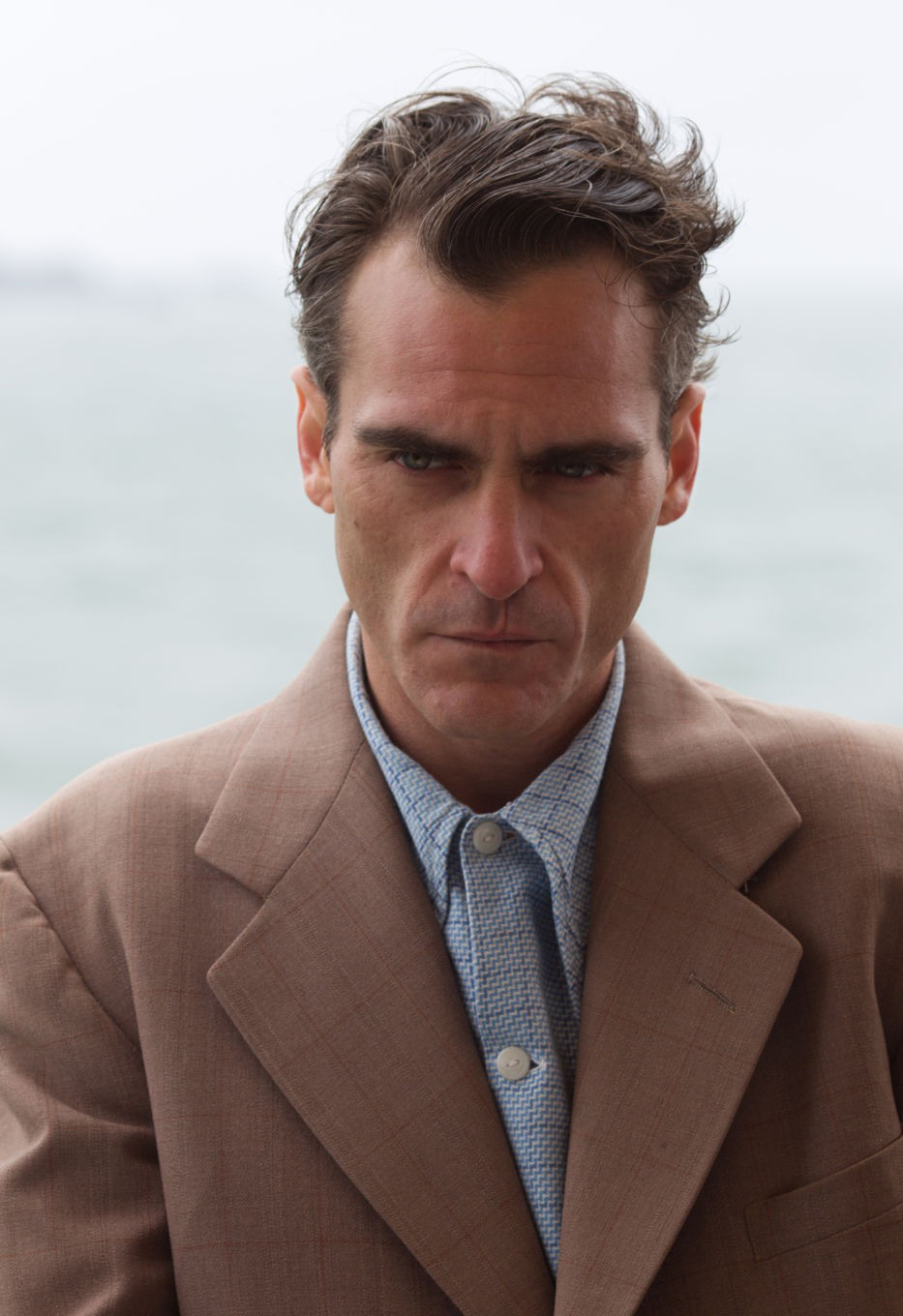
Joaquin Phoenix plays the impetuous Freddie Quell, who, psychologically damaged from his experiences, drunkenly saunters from job to job, conjuring up alcoholic potions on his way and attempting to fulfil his sexual longings. He then stumbles upon Lancaster Dodd (Hoffman) , a.k.a The Master, who takes Quell under his wing in the attempt to “cure”  him through his leadership of “The Cause”. 

More of a character study than a plot-driven film ("We're low on story, we're high on character" says Anderson himself), Phoenix and Hoffman’s roles are fascinating and their performances are nothing short of spectacular. Phoenix may play his usual temperamental character but he is so convincing and often funny that scenes without him feel empty. Many are putting Hoffman on the pedestal and he will undoubtedly garner an Oscar nomination, yet I find Phoenix to be equally, if not more, impressive. The leads compliment each other perfectly with the processing scene being their most engaging encounter and hitting the peak of Phoenix's performance. Amy Adams is also a great addition to the cast as she shows Peggy's influence over the seemingly all powerful Master.

Shot in 70mm (highly recommended to see it in this format if you fancy a trip to the Odeon West End), the film is visually breathtaking on the big screen. Dazzling images of the sea contrast with intense close-ups of our characters, accompanied with a subtle and intriguing wood-based score from Radiohead’s Jonny Greenwood.

The film is not for everybody though (including my mother who wasn't the best person to take). It’s often challenging in nature by a lack of progressive story line and conclusive end. As Anderson points out, the characters "start the same, and they end the same", which can be quite frustrating for some viewers. 

In my opinion, its only downfall is its ending. Whereas There Will Be Blood’s finale was explosive, shocking and utterly brilliant (“I’m finished” being Daniel Plainview’s final on-screen utterance), The Master fizzles out. At 140 odd minutes, the film is quite long but that would not have been an issue had the intriguing sequences been sustained throughout.  It is testimony to Anderson’s skill, however, that it still remains one of the year’s best films. 

An Oscar front runner? 

As will become apparent over the next few months, I absolutely love Award Season. With a nation-wide UK release of mid-November, The Master is one of the first films to enter the Oscar-sphere, most likely on the part of producer Harvey Weinstein.

Anderson is clearly an actor's director as the majority of his films have garnered Oscar nominations for some of its stars and this will not be an exception. Phoenix are Hoffman are sure to get nods for Best Actor and Best Supporting Actor respectively and I would personally love to see Phoenix take away a statuette.

However, is the film itself too unconventional for the Academy?

The latest trailer for Spielberg’s Lincoln, starring Daniel Day-Lewis (who shone in PTA’s last) in the title role, seems a more traditional historical epic that will likely please the Academy the same way that The King’s Speech did; an iconic leader overcoming his difficulties to fulfil righteous acts, blah blah. There Will Be Blood missed out on the 2008 Best Picture to the Coen Brothers’ dark No Country For Old Men¸ and though equally impressive was undoubtedly less adventurous than Anderson’s offering. Life of Pi, Cloud Atlas and The Hobbit seem to be others discussed as Oscar front runners, all of which won't come as a surprise. 

Though the performances are strong, the characters do fail to reach any enlightening conclusion and none are particularly honourable, aspects that may alienate some voters. Hopefully, though, they will honour the individual, creative film-making of Anderson that escapes Hollywood confines to give a thought-provoking piece of cinema.

No matter how it performs in Award Season, The Master is definitely one of my favourite films of the year and I still cannot stop thinking about it.

9/10 

Monday, 8 October 2012

Rust and Bone

De Rouille et D’os

2012
Director: Jacques Audiard
Writer: Jacques Audiard, Thomas Bidegain, 
Cast: Marion Cotillard, Matthias Schoenaerts

Nominated for the prestigious Palme D’or at the 2012 Cannes Film Festival, Jacques Audiard, director of 2009’s tour de force, A Prophet, returns to the international stage with a simply told yet powerful love story. 

A brief meeting in a night club transforms itself into a strong yet turbulent relationship as killer whale trainer Stéphanie (Cotillard) calls upon the help of struggling single father and aspirational fighter Alain after she loses her legs in a tragic accident.

Free from Hollywood’s constraints and its often sentimental love stories, Rust and Bone is intelligent and fresh as stunning cinematography accompanies the film’s thought-provoking plot and emotional sequences. Cotillard’s terrific performance, particularly compelling when Stéphanie learns of her fate, will most likely garner her a number of nominations this award season but Schoenaerts’ portrayal is equally as honest and moving. 

8/10